
Acne Scar Consultations in Gangnam: 10 Questions We Hear Most Often
Will my scars disappear? How many sessions do I need? How long is recovery? Lee Ji-seung answers the 10 questions we hear most often in scar and acne consultations at Medical Bloom Korean Medicine Clinic · COEX.
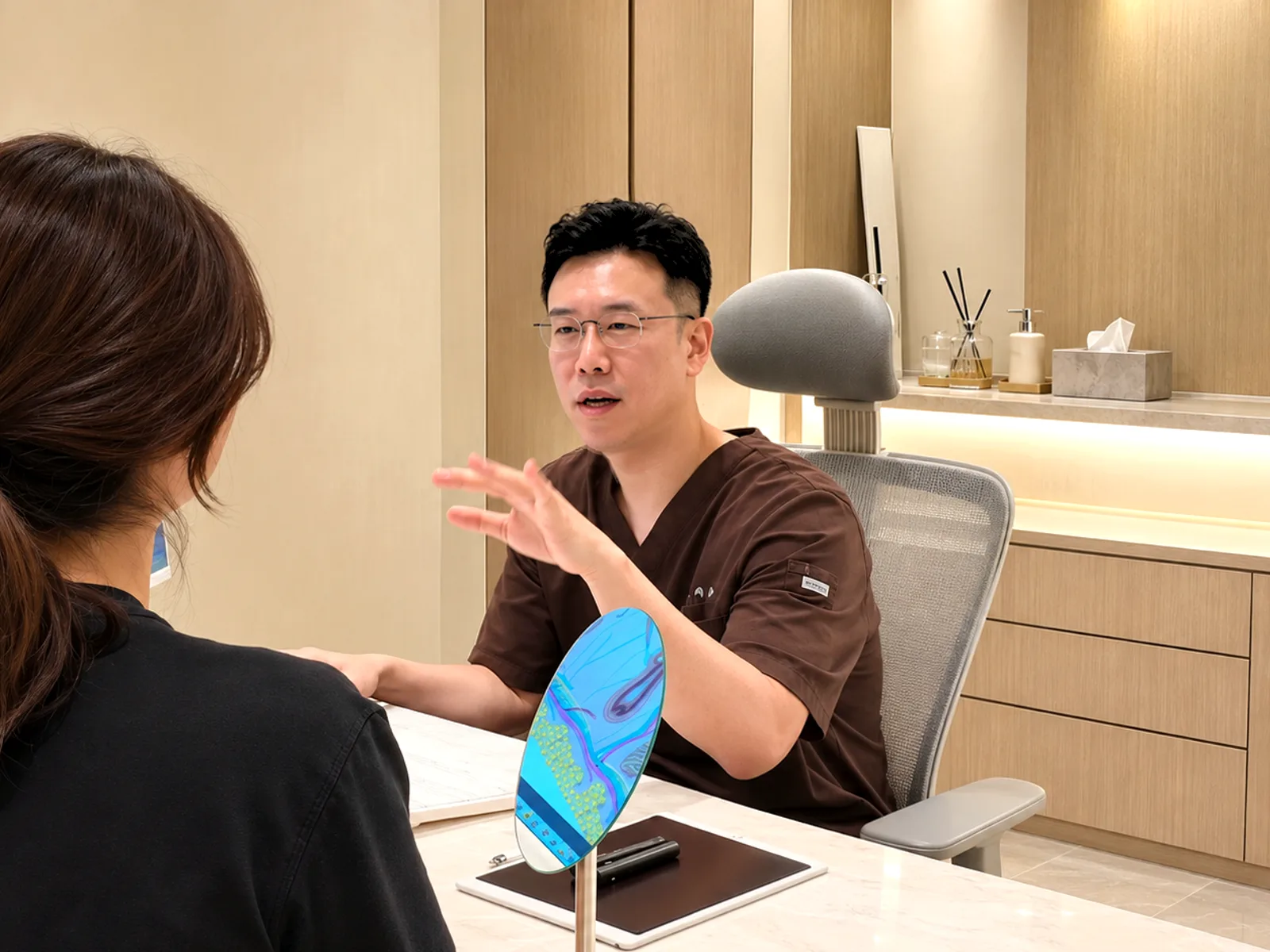
Summary: If you are looking into acne scar treatment in Gangnam, treatment begins with identifying the type of scar. We have gathered the 10 questions we hear most often in scar and acne consultations at Medical Bloom Korean Medicine Clinic · COEX, with a link to a more detailed article at the end of each answer.
Written by: Lee Ji-seung, Medical Director (Korean Medicine Doctor, PhD in Eastern and Western Medicine) · Date: 2026.11.9
Hello, I'm Lee Ji-seung, Medical Director of Medical Bloom Korean Medicine Clinic · COEX. Over the past month, I have posted a series of articles about scars and acne. Today I have gathered in one place the 10 questions I am asked most often in the consultation room. Start with the questions you are curious about, and if you want to know more, see the linked articles.
Before You Read: Scars and Marks at a Glance
Most of the 10 answers below depend on "what kind of scar it is." First check which type your concern is closest to.
- Ice pick scars — Narrow, deep holes. Up close, they look like pinpricks. Treatment addresses the base of each scar one by one.
- Boxcar scars — Sharp edges with a flat base. Under angled light, they cast angular shadows. Treatment is planned separately by depth.
- Rolling scars — Wide, gentle, wave-like depressions. They look less visible when the skin is stretched. Treatment addresses skin texture over a wide area.
- Red marks — Flat surface, pink to red in color. They briefly turn pale when pressed. Treatment reduces irritation and calms blood vessels.
- Brown marks — Flat surface, brown in color. The color stays the same when pressed. Treatment involves sun protection and reducing melanin.
Most faces have several types mixed together. We confirm the exact type together during your consultation by shining a light on the skin.
Frequently Asked Questions
Q. Will my scars disappear completely?
It is difficult to remove depressed acne scars completely; the goal of treatment is to reduce their depth and shadows so they are less noticeable. How much they change depends on the type and depth of the scars and how quickly your skin recovers (individual results vary).
At the first consultation, I shine a light at an angle and record the scars as ice pick, boxcar or rolling. Narrow, deep ice pick scars and wide, gentle rolling scars are difficult to treat the same way. We compare photos taken under the same lighting at each session to check the changes together.
If the change you expect differs from what is actually possible, you may still feel disappointed after treatment ends. So at the consultation, I first ask which area bothers you most and how much change you hope for, and then make a plan.
→ Read more: Acne Scars and Pores: Why Do the Treatments Differ?
Q. How many sessions do I need?
Acne scar treatment usually does not end in one session; it is done several times, with time between sessions for the skin to recover. The number of sessions and intervals depend on the type and depth of the scars, the treatment method and how quickly you recover.
At the first consultation, I tell you the expected number of sessions, then compare photos at each session and adjust the next plan. New collagen takes time to form, so results are judged a few months after the last treatment. Treatment is usually given at 3–5 week intervals, and the number of sessions depends on the type and depth of the scars and the condition of your acne. Each session usually brings about 15–20% improvement (individual results vary).
We leave time between sessions because the skin needs time to recover and produce collagen. If the next treatment comes too early, skin that has not finished recovering is irritated again, and redness or pigmentation may last longer.
Q. How long does recovery take?
After scar treatment, redness and swelling usually appear first, and a few days later small scabs form and fall off as the skin recovers. Recovery time depends on the treatment method and intensity. With BLOOM scar needle, redness and scabbing usually last about 5–10 days, depending on the type and depth of the scars. With POTENZA, redness is strongest on the first day, followed by only slight redness for 2–3 days, so recovery is not long.
During recovery, it is most important not to pick at scabs and to protect your skin from the sun. Picking scabs can easily leave brown marks. If you have work or a photo shoot coming up, please let us know when we set your treatment date.
Many people have treatment on a Friday evening and wait for the swelling to go down over the weekend. While scabs remain, covering them with a mask and hat is better for recovery than heavy makeup.
Q. Can old scars be treated?
Yes. Old scars have a settled shape, which actually makes it easier to identify the scar type and plan treatment.
However, the harder the base of the scar has become, the more slowly change appears. Scars from surgery or accidents can also be evaluated in consultation one month after the wound has healed. Raised red hypertrophic scars and keloids call for a different approach from depressed scars, so we check your constitution first.
Many people with old scars have already tried several treatments. If you tell us the names of previous treatments, when you had them and how your skin responded, it helps a great deal in deciding whether to repeat the same method or add a different one.
→ Read more: Samseong & COEX: Can Scar Needle Treat Surgical Scars?
Q. I still get acne. Can I start scar treatment?
Areas with active inflammation are often treated for inflammation first, and scar treatment begins in areas where inflammation has calmed down. If new acne keeps forming, new scars will keep forming too.
I divide acne into stages — whiteheads and blackheads (comedones), papules, pustules, and nodules and cysts — and set the treatment order area by area across the face. Sometimes we plan inflammation treatment on one side and scar treatment on the other on the same day.
If your acne keeps coming back, it may not be a skin-only issue. I also ask whether your acne increases with sleep, stress or your menstrual cycle, and if needed, add treatment to manage the factors behind recurrence.
→ Read more: Will Popping Pimples Cause Scars? 5 Habits That Leave Scars
Q. Should I choose scar needle or POTENZA?
BLOOM scar needle is strong at precisely treating the base of each individual scar, while POTENZA is strong at treating skin texture and pores over a wide area together. We divide the weight of the two treatments depending on whether your scars are deep and narrow or spread out widely.
In practice, most faces have several types of scars mixed together, so we often plan both rather than choosing just one. If pores are also a concern, we sometimes increase the weight of POTENZA.
Both treatments use the skin's own recovery process, so redness and small scabs may appear after treatment. Which one comes first is decided by looking at how your scars are distributed along with your schedule.
→ Read more: How Does POTENZA Work on Acne Scars and Pores?
Q. Who is Gold PTT right for?
Gold PTT is a photothermal treatment in which gold particles are absorbed into the pores and sebaceous glands, and then a laser delivers heat to those areas. Because it targets the sebaceous glands that cause acne to keep coming back, it is mainly considered for people who often get inflammatory acne in the same spots.
On the other hand, if you rarely get acne and only scars remain, scar treatment comes before Gold PTT. If you are taking oral acne medication or have taken it recently, please be sure to tell us at your consultation.
Gold PTT addresses the sebaceous glands, while treatments such as PN Rebuilder T support recovery of skin weakened after inflammation calms down. I decide the order of the two depending on the stage of your acne.
→ Read more: What Skin Is PN Rebuilder T (Trouble Line) Used For?
Q. How can I tell red marks from scars?
In front of a mirror, shine a light at an angle from the side of your face. If a shadow forms, it is a depressed scar; if you see only color and the surface is flat, it is a mark.
If a mark turns pale when you press it lightly with your finger, it is a red mark caused by capillaries; if the color stays the same, it is a brown mark caused by melanin. Marks are more likely than scars to fade on their own, and sun protection comes first.
When red marks overlap scars, the scars look more prominent. In these cases, just fading the marks can change how noticeable the scars are, so I plan treatment for marks and scars separately.
Q. Do I have to take herbal medicine?
No. You can receive scar or acne treatment alone. I recommend herbal medicine only when breakouts keep coming back or when body conditions such as sleep, digestion or the menstrual cycle affect your skin, and you decide for yourself whether to take it.
Most skin procedures can be done while you are taking herbal medicine. However, some herbs can make the skin more sensitive to light or make bruising more likely, so I coordinate your prescription and procedure schedule together.
If you are taking herbal medicine, medication or supplements prescribed elsewhere, please show us the names or a photo of the packaging at your consultation. We need this to coordinate your procedure dates with your medication schedule.
Q. How should I plan my schedule if I am coming from abroad?
If you let us know your arrival and departure dates when you book, we will set your treatment dates with the time needed for redness and scabs to settle in mind. Procedures that need recovery time, such as scar treatment, are easier to have early in your stay.
Scar treatment is often done over several sessions, so I separate what to do on this visit from what to do on your next visit. We can consult in English, Chinese and Japanese, and if you need an interpreter, please be sure to book in advance. We will also explain how to contact us after you return home when you book.
If you must have treatment the day before your departure, we sometimes change the plan to focus on procedures with shorter recovery. The air on the plane is dry, so bring moisturizer, and it is important to keep using sun protection after you return home.
What We Decide Together at Your First Consultation
The answers to the questions above all come together into one plan at your first consultation. At the end of the consultation, I summarize the following four things with you.
- Condition of your scars and acne — How each type of scar is distributed and what stage your acne is at now
- Treatment order — Whether to treat inflammation or scars first, and which treatments to use together
- Schedule — Expected number of sessions and intervals, recovery time, and dates to avoid
- What to do at home — Cleansing and skincare products, sun protection, and habits worth changing
You do not have to start treatment that day. You can hear the plan and decide according to your schedule. We also compare photos at each session and adjust the plan during treatment, so the first plan does not necessarily stay the same until the end.
What to Prepare Before Your Consultation
- When your scars formed and what treatments you have had so far
- Medications you are taking, especially oral acne medication, herbal medicine and supplements
- Whether you are prone to keloids or have skin allergies
- Your schedule for the week after treatment (work, photo shoots, departure)
- The cleansers and skincare products you currently use
Temporary redness, swelling, bruising, scabbing or pigmentation may occur after the procedure, and results and side effects can vary from person to person. Please consult thoroughly with your clinician before undergoing a procedure.
At Medical Bloom Korean Medicine Clinic · COEX, we look at the type of scars, the stage of your acne and your daily schedule together to guide your treatment plan. If you have a question that is not covered here, please feel free to contact us. Medical Bloom Korean Medicine Clinic · COEX is a 4-minute walk from Exits 9·10 of Seolleung Station.
References
- Fabbrocini G, Annunziata MC, D'Arco V, et al. Acne scars: pathogenesis, classification and treatment. Dermatol Res Pract. 2010;2010:893080.
- Jacob CI, Dover JS, Kaminer MS. Acne scarring: a classification system and review of treatment options. J Am Acad Dermatol. 2001;45(1):109-117.
- Reynolds RV, Yeung H, Cheng CE, et al. Guidelines of care for the management of acne vulgaris. J Am Acad Dermatol. 2024;90(5):1006.e1-1006.e30.
* This article is for medical information purposes. Results and recovery vary by individual; an in-clinic consultation is required for an accurate diagnosis and treatment plan.